Our History

Over four decades of faith, prayer and community in Gayathripuram

How it began

St Anthony's Church, Gayathripuram grew from a small community gathered in prayer under the patronage of St Anthony of Padua — the patron of the poor and of all who have lost something.

In the early days there was no church building. Our community came together at a sub-station in the premises of the Indian Air Force, next to Jyothi Nagar, where space was kindly given for the celebration of Holy Mass.

Later, under Most Rev. Dr Mathias Fernandes, Bishop of Mysore, our own church was built. On 19 September 1984, His Excellency the Most Rev. Acaciavillian blessed the new church dedicated to St Anthony, with the Bishop of Mysore also present. A commemorative stone for St Anthony's High School, to serve Kannada-medium students, was blessed on the same day. Rev. Fr M. Gregorios, then Parish Priest of the Cathedral, took great pains over the construction of the church and the school.

After the church was built, Assistant Parish Priests of St Joseph's Cathedral, Mysore, came to celebrate Mass here — Rev. Fr. Paulus and Rev. Fr. George Martis (1984–85), then Rev. Fr. Arogya Swamy and Rev. Fr. William Albukkar (1986–87) — until Rev. Fr. Joseph Saldana became our first Parish Priest in 1987.

Since then the parish has been shepherded by Rev. Fr. C Rayappa (1989–95), Rev. Fr. G Joseph (1995–2001), Rev. Fr. Aloysius Menezes (2001–07), Rev. Fr. Arul Raj (2008–13), Rev. Fr. Christy Sam (2014–18) and Rev. Fr. Arogya Swamy (2020–25). Today our Parish Priest is Rev. Fr. Rony Ravi Kumar. Generations of priests, sisters and parishioners have given their time, their prayers and their gifts, so that the faith could be handed on and the doors of the church stayed open to all.
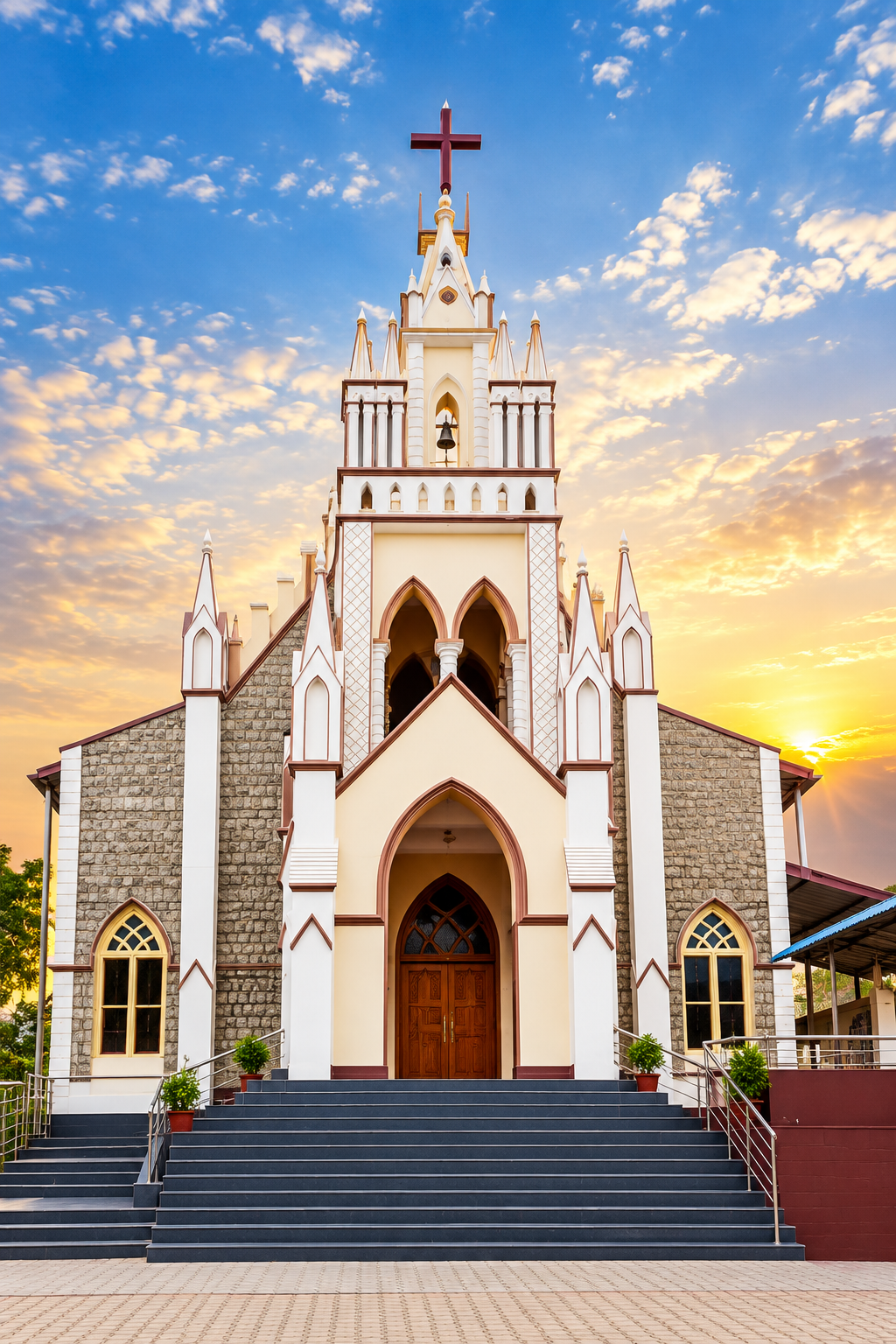
St Anthony's Church, Gayathripuram

Milestones

The moments that shaped our parish

Early days

A sub-station in the Air Force

Before the church was built, Mass was celebrated at a sub-station in Indian Air Force premises beside Jyothi Nagar, where space was given to our community.

1984

The church is blessed

On 19 September 1984 the Most Rev. Acaciavillian blessed the new church dedicated to St Anthony, in the presence of Most Rev. Dr Mathias Fernandes, Bishop of Mysore. Rev. Fr M. Gregorios oversaw its construction.

1984

St Anthony's High School

A commemorative stone was blessed for St Anthony's High School, to serve the needs of Kannada-medium students.

1984 – 87

A sub-station of the Cathedral

Assistant Parish Priests of St Joseph's Cathedral, Mysore, celebrated Mass here: Fr. Paulus, Fr. George Martis, Fr. Arogya Swamy and Fr. William Albukkar.

1987

The first Parish Priest

Rev. Fr. Joseph Saldana (1987–89) becomes the first Parish Priest of St Anthony’s Church.

1989 – 2018

Parish Priests through the years

Fr. C Rayappa (1989–95), Fr. G Joseph (1995–2001), Fr. Aloysius Menezes (2001–07), Fr. Arul Raj (2008–13) and Fr. Christy Sam (2014–18) each shepherded the parish in turn.

2020 – 2025

Fr. Arogya Swamy

Rev. Fr. Arogya Swamy, who had celebrated Mass here as an Assistant Priest in 1986–87, returns to serve as Parish Priest.

2026

A new Parish Council

With the blessings of the Bishop of Mysore, a new Parish Council Committee was formed on 11 October 2026.

Today

A parish family

Under Rev. Fr. Rony Ravi Kumar: more than 300 families, six ministries and seven weekly Masses — still growing together in faith.

St Anthony of Padua

A gifted preacher and teacher, and a friend of the poor, St Anthony is loved around the world as the patron of those in need and of everyone who is searching for something lost.

He was born Fernando de Bulhões to a noble family in Lisbon, Portugal, on 15 August 1195. At about fifteen he joined the Augustinian Canons. In 1220 the bodies of five Franciscan friars, martyred in Morocco for the Gospel, were brought to Coimbra, and Fernando longed to give his own life in the same way. He joined the Franciscans, took the name Anthony, and set out for Morocco, but illness forced him to turn back.

He reached Assisi for the great gathering of friars in 1221. His deep knowledge of Scripture soon became known: he became the first teacher of theology to the Franciscans, and preached in northern Italy and southern France. He made the city of Padua his home, where crowds came to hear him. He died on 13 June 1231 at Arcella, near Padua, aged only 35, saying, “I see my Lord.”

Pope Gregory IX declared him a saint at Spoleto on 30 May 1232, less than a year after his death. In 1946 Pope Pius XII named him a Doctor of the Church, with the title “Evangelical Doctor”. His tongue, the sign of his preaching, was found unharmed when his relics were moved in 1263, and it is still kept in the Basilica of St Anthony in Padua.

Catholics have long turned to him to find what is lost, from keys and papers to faith and peace. He is shown holding the Child Jesus, with a lily and the Gospel book. Because he was buried on a Tuesday, Tuesday has become the day of special devotion to him, and our parish prayer group meets on Tuesdays.

Born
Lisbon, Portugal, 15 August 1195 (as Fernando)
Died
Arcella, near Padua, Italy, 13 June 1231
Canonised
30 May 1232, by Pope Gregory IX
Doctor of the Church
Declared by Pope Pius XII, 16 January 1946
Feast day
13 June
Shrine
Basilica of St Anthony, Padua

Each year our parish keeps his feast in June with a novena of prayer and a solemn feast Mass.